



Regulatory compliance for cosmetic products depends heavily on accurate and standardized ingredient labelling. The cosmetic label is the main point of communication between the manufacturer and the consumer. It provides essential information related to product safety, proper use, and informed purchasing decisions. In the European Union, compliance with Regulation (EC) No 1223/2009 is mandatory for all cosmetic products placed on the market.
The INCI Standard and Ingredient Uniformity
The foundation of cosmetic ingredient labelling is the mandatory use of INCI (International Nomenclature of Cosmetic Ingredients) names. INCI provides a globally harmonized naming system that ensures consistency across all markets, regardless of local language requirements. For example, water is always declared as “Aqua,” and preservatives or functional ingredients must be listed by their standardized INCI names rather than trade or brand names.
Ingredients must be listed in descending order of weight at the time the formulation is prepared. The ingredient used in the highest concentration appears first on the list, while the ingredient used in the lowest concentration appears last.
Rules for Low-Concentration Ingredients and Colorants
EU cosmetic legislation allows specific exceptions to the standard descending order rule to reflect formulation realities.
Ingredients present at concentrations below 1% may be listed in any order after all ingredients used at 1% or higher. This flexibility avoids frequent label changes caused by minor formulation adjustments at very low levels.
Colorants follow separate rules. They are always listed at the end of the ingredient list and must be identified by their Colour Index (CI) numbers, such as CI 77891 for titanium dioxide. For decorative cosmetics sold in multiple shades, manufacturers may list all colorants used across the range. In such cases, the list is preceded by the phrase “May contain” or the ± symbol.
Fragrance and Aroma Declarations
Fragrance and aroma ingredients are generally declared using the terms “Parfum” or “Aroma.” However, this rule has important limitations. If a fragrance mixture contains any allergenic substances listed in Annex III of Regulation (EC) No 1223/2009, those substances must be declared individually. This applies when their concentration exceeds defined threshold levels, even if they are only present as part of the fragrance composition.
Placement and Legibility Requirements
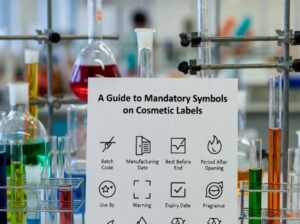
The ingredient list must be clearly visible, easy to read, and indelible on the cosmetic packaging. When the primary packaging is too small to display the full ingredient list, the information must be provided on an attached leaflet, label, or tag. In such cases, the packaging must display the “Refer to Enclosed Information” symbol to guide consumers.
Ensuring Ongoing Compliance
Ingredient labelling compliance requires careful attention to INCI nomenclature, correct sequencing, allergen disclosure, and proper label placement. Accurate and transparent ingredient lists help protect consumer safety, support regulatory inspections, and ensure uninterrupted access to the EU cosmetics market.
The fragrance allergen expansion you must label for
For years, 26 fragrance allergens had to be declared individually on the ingredient list once they exceeded 0.001% in leave-on products or 0.01% in rinse-off products. Regulation (EU) 2023/1545 amended Annex III and expanded that list dramatically, taking the number of individually declarable fragrance substances past 80.
The practical consequence is that a fragrance you have used unchanged for years may now require several additional names on the label, even though nothing about the formulation has changed. The thresholds themselves are unchanged — what has changed is how many substances are caught by them.
Transition periods apply, with newly placed products required to comply first and a longer sell-through window for stock already on the market. Because the information has to come from your fragrance supplier, the bottleneck is rarely the label itself — it is obtaining an updated allergen declaration for every fragrance and essential oil in the formula. Request those declarations early, since artwork cannot be finalised without them.
Nanomaterials and the [nano] suffix
Ingredients present as nanomaterials must be identified in the ingredient list by their INCI name followed by the word “[nano]” in square brackets. This applies to common UV filters and pigments such as titanium dioxide and zinc oxide when they are used in nano form.
The labelling obligation sits alongside a separate notification duty: products containing nanomaterials must be notified to the Commission six months before being placed on the market, in addition to the standard CPNP notification. Missing the suffix is a labelling non-compliance; missing the notification is a market-access problem, and the two are assessed separately.
The ingredient list mistakes that force a reprint
Most ingredient-list failures are avoidable and are caught late, once artwork is already at the printer. The recurring ones are worth checking explicitly:
- Using trade names or marketing names instead of INCI names — “shea butter” rather than Butyrospermum Parkii Butter
- Listing the supplier’s raw material as a single entry when it is actually a blend that must be broken down into its constituent INCI names
- Ordering by the percentage of the raw material rather than the percentage of the actual ingredient in the finished formula
- Omitting fragrance allergens that sit above the threshold, or declaring them but leaving them out of the descending order
- Placing colorants in the main body of the list instead of at the end, or using colour names rather than CI numbers
- Heading the list with anything other than “Ingredients” — the word itself is required
Each of these is cheap to fix on a draft and expensive to fix on 20,000 printed cartons. The ingredient list should be verified against the final, signed-off formulation and the supplier documentation before artwork is approved, not after.
Frequently asked questions
Does the ingredient list have to be translated into local languages?
No. INCI names are a standardised nomenclature and stay identical in every Member State — that is the point of the system. Other label elements such as warnings, function and instructions for use do have to appear in the language required by the country where the product is sold.
How do I order ingredients that are all below 1%?
Once you reach ingredients present at less than 1%, they may be listed in any order after those at 1% or above. You are not required to know or disclose their exact relative concentrations, which avoids relabelling every time a minor component is adjusted.
What if the packaging is too small for the full list?
The information may be given on an enclosed leaflet, label, tag, tape or card, and the packaging must then carry the “refer to enclosed information” symbol — the hand pointing to an open book. The information cannot simply be omitted or moved to a website.
Do I have to declare water?
Yes, and it is declared as “Aqua”. Because it is usually the largest component of an emulsion, it normally appears first in the descending order.
From INCI nomenclature to allergen thresholds, we support your cosmetic labelling compliance in the EU. Get in touch today.