



EU Regulation (EC) No 1223/2009 establishes the legal definition of a cosmetic product and forms the basis for all cosmetic compliance requirements within the European Union. This definition plays a critical role in determining whether a product falls under cosmetic legislation or is subject to alternative regulatory frameworks.
The classification relies strictly on two criteria: the area of application and the product’s exclusive or primary function.
Legal Criteria Used to Define a Cosmetic Product in the EU
EU law relies on two decisive factors to classify a product as a cosmetic: the area of application and the product’s exclusive or primary function.
A cosmetic product is any substance or mixture intended to be placed in contact with the external parts of the human body, including the epidermis, hair system, nails, lips, and external genital organs. The definition also includes products applied to the teeth and the mucous membranes of the oral cavity.
The intended purpose must be exclusively or mainly cosmetic, such as cleaning, perfuming, changing appearance, protecting, keeping the body in good condition, or correcting body odours.
Examples of Products That Qualify as Cosmetic Products Under EU Law
Many everyday consumer items clearly meet the EU cosmetic product definition.
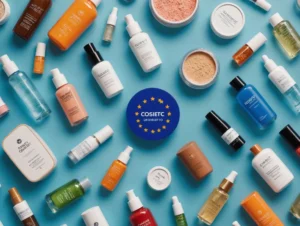
Skincare products, including moisturizers, toners, and facial oils, qualify as cosmetic products because their primary function is to protect the skin and maintain its condition.
Makeup products such as foundation, mascara, and lipstick also fall under EU cosmetic regulation, as their main purpose is to change or enhance appearance.
Borderline Products Under EU Cosmetic Regulation
Some products do not clearly qualify as cosmetic products under EU law and may fall under medicinal product or medical device legislation. These borderline products require a detailed, case-by-case regulatory assessment.
Authorities evaluate intended use and product claims closely. Products that claim to treat or prevent disease, or that suggest pharmacological action, fall outside the cosmetic product definition. For example, a basic moisturizing cream is a cosmetic, while a product making therapeutic anti-itch claims may be classified as a medicine.
Regulators also assess the mode of action. Cosmetic products act superficially and do not modify physiological functions through systemic mechanisms.
Cosmetic Product vs Medicinal Product Classification in the EU
EU legislation applies a strict rule when a product appears to meet both the cosmetic and medicinal definitions. In such cases, authorities always classify the product as a medicinal product.
This principle prevents companies from avoiding the extensive testing and authorization requirements applicable to medicines. Correct classification therefore represents a critical compliance step when placing products on the EU market.
Need help with EU cosmetic product classification? Contact our regulatory specialists.
The borderline: cosmetic, medicinal or biocidal product
Most classification disputes do not turn on what a product contains, but on what it is presented as doing. A product that claims to treat, prevent or cure a condition is presented as a medicinal product, and the medicinal framework takes precedence — even if the formulation would otherwise sit comfortably within the cosmetic definition.
Three signals push a product across the line. The first is the claim itself: “relieves eczema” or “treats acne” are therapeutic claims, while “soothes dry skin” and “helps reduce the appearance of blemishes” remain cosmetic. The second is the mechanism: a product that acts pharmacologically, immunologically or metabolically is medicinal by function, regardless of how it is marketed. The third is the presence of an active substance at a concentration that produces a therapeutic effect.
Products whose primary purpose is to destroy or control harmful organisms fall under the Biocidal Products Regulation instead. A hand gel marketed for cleansing is a cosmetic; the same gel marketed as killing 99.9% of bacteria is making a biocidal claim and needs biocidal authorisation.
Products that are not cosmetics under EU law
Several product categories are commonly assumed to be cosmetic but sit outside the definition entirely:
- Products intended to be ingested, inhaled, injected or implanted — the definition covers external parts of the body, the teeth and the mucous membranes of the oral cavity only
- Tattoo inks and permanent make-up pigments, which are placed in the dermis rather than applied to the skin surface
- Products for cleaning surfaces or textiles rather than the body, which are governed by detergent and chemical legislation
- Devices that act by physical means, such as certain exfoliating tools or applicators sold on their own
Food supplements marketed for skin or hair benefits are a frequent source of confusion. Because they are ingested, they are food, not cosmetics, no matter how closely the marketing resembles a beauty product.
Why classification decides your entire compliance route
Classification is the first decision in any market-entry project because everything downstream depends on it. If the product is a cosmetic, you need an EU-established Responsible Person, a Product Information File, a Cosmetic Product Safety Report signed by a qualified assessor, and a CPNP notification before the product goes on sale. There is no pre-market authorisation and no approval number.
If the product is medicinal, it requires a marketing authorisation, which is a fundamentally different process in cost, evidence and timeline. If it is biocidal, the active substance must be approved and the product authorised. Getting this wrong is expensive in both directions: treating a medicinal product as a cosmetic exposes you to enforcement and withdrawal, while treating a cosmetic as a medicine burdens a simple product with an authorisation process it never needed.
Because presentation drives classification, the decision should be made before marketing copy is finalised, not after. A single sentence on a label or a website can move a product from one regulatory regime to another.
Frequently asked questions
Does the same product have to be classified the same way in every EU country?
In principle yes, because the definition is harmonised. In practice national authorities have historically taken differing views on borderline products, so a product accepted as a cosmetic in one Member State can be challenged in another. Where doubt exists, the safest route is to document the reasoning behind the classification in the Product Information File.
Can a product be both a cosmetic and a medicinal product?
No. The two regimes are mutually exclusive. Where a product meets the definition of a medicinal product, the medicinal legislation applies exclusively, even if it also satisfies the cosmetic definition.
Is soap a cosmetic under EU law?
Yes. Soap intended for cleansing the skin is a cosmetic product and needs a safety assessment, a Responsible Person and a CPNP notification like any other cosmetic. Soap sold for cleaning surfaces rather than the body is not.
Who decides whether my product is a cosmetic?
You do, in the first instance — classification is a self-assessment. National competent authorities can disagree and take enforcement action, which is why the reasoning behind the classification should be recorded and defensible before launch.