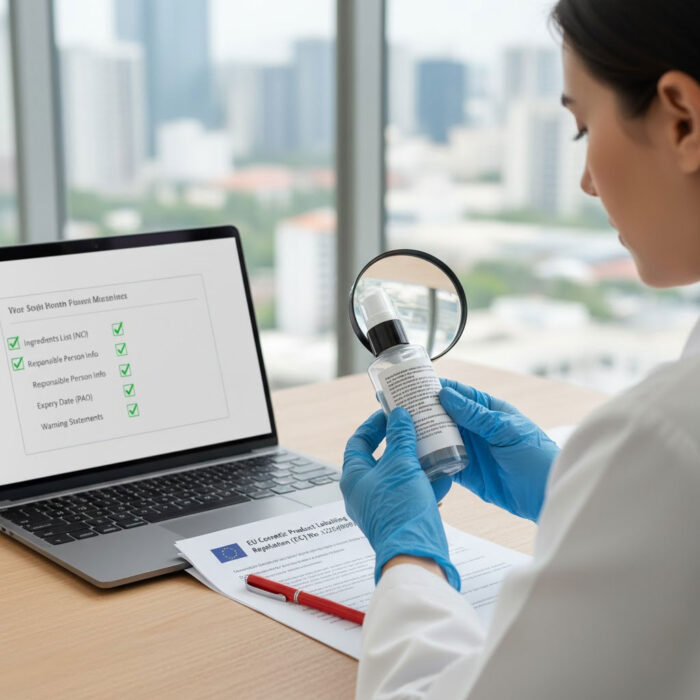
Cosmetic Claims Compliance Check
A regulatory review of the claims you want to make — anti-ageing, dermatologically tested, clinically proven, natural, organic, hypoallergenic — against the EU common criteria. Where a claim will not stand up, we tell you what would make it defensible or suggest wording that will.
€ 100.00
Why claims are where enforcement actually lands
Formulation problems are rare and usually caught before launch. Claims problems are common, visible on the front of the pack, and are what competitors and national authorities report. Under Regulation (EU) No 655/2013 every cosmetic claim must satisfy six common criteria — legal compliance, truthfulness, evidential support, honesty, fairness and informed decision-making — and "everyone else says it" is not one of them.
Claims we look at every week
- Anti-ageing. Where the line sits between an acceptable cosmetic claim and an implied medicinal effect.
- Dermatologically tested. A claim about a test having happened, which means the test has to have happened, on this product, with retained records.
- Clinically proven. The highest evidential bar of the common ones, and the most frequently used without the study behind it.
- Natural and organic. Not defined in EU cosmetics law, which makes them more exposed rather than less — the claim has to be honest and not mislead about the actual composition.
- Hypoallergenic. Held to a strict standard: it implies a very low risk of allergic reaction and must be supported accordingly.
- Free-from claims. Restricted by the Technical Document on Claims, particularly where they denigrate a legally permitted ingredient.
What you receive
- Every claim assessed against the six common criteria, with a clear verdict.
- For claims that fail: why, and alternative wording that carries the same marketing intent legally.
- For claims that could work: the specific evidence or testing needed to support them.
- A written report you can hand to your agency or your printer.
What we need from you
- The claims you intend to make — pack copy, website copy, or both.
- Your formulation, so we can judge whether a composition claim is accurate.
- Any test reports or studies you already hold.
Why check claims before printing
- Relabelling is the expensive outcome. A claim caught at draft stage costs a wording change; the same claim caught after a print run costs the print run.
- Marketplaces enforce too. Amazon and the large European retailers remove listings over unsupported claims, often faster than a regulator would.
- We suggest alternatives. The point is not to strip your marketing back to nothing, but to find the version of the claim you can actually defend.
- You learn what evidence costs. Sometimes the right answer is to run the study. We tell you which one and roughly what it involves.
Cosmetic Claims Compliance Check
Q & A
Claims are half the label risk
The other half is Article 19: ingredient list, nominal content, PAO, batch code and Responsible Person details. Our label review covers all of it.
Often needed together
INCI List Preparation & Review
Cosmetic Formula Screening (Annex III–VI)
Reviews
There are no reviews yet