Safety Assessment for Face Serum
CPSR for a face serum — high active concentrations, daily leave-on facial exposure, and the Annex…
Price range: € 150.00 through € 500.00
Options




A Cosmetic Product Safety Report for a face cream or moisturiser — an emulsion left on facial skin daily, where preservation, emulsion stability and any SPF claim all have to hold together.
Price range: € 150.00 through € 500.00
Choose your formula size above and order online — no consultation call required.
We send a secure intake listing exactly what we need for a face cream. The checklist below is the usual set.
Your assessor reviews the formulation against Annexes II–VI and calculates exposure. If tests are missing we arrange them with our partner laboratories.
You receive the signed CPSR digitally, ready to go into your Product Information File.
A face cream is an emulsion, and emulsions fail in ways that anhydrous products cannot: the water phase supports microbial growth, the preservative can partition into the oil phase and stop working where it is needed, and separation over shelf life changes the dose the consumer actually applies. A safety assessment under Regulation (EC) No 1223/2009 has to account for all three.
You receive a complete CPSR, Part A and Part B, with the exposure assessment based on daily leave-on application to facial skin.
A complete Cosmetic Product Safety Report in two parts, prepared and signed by a qualified Safety Assessor:
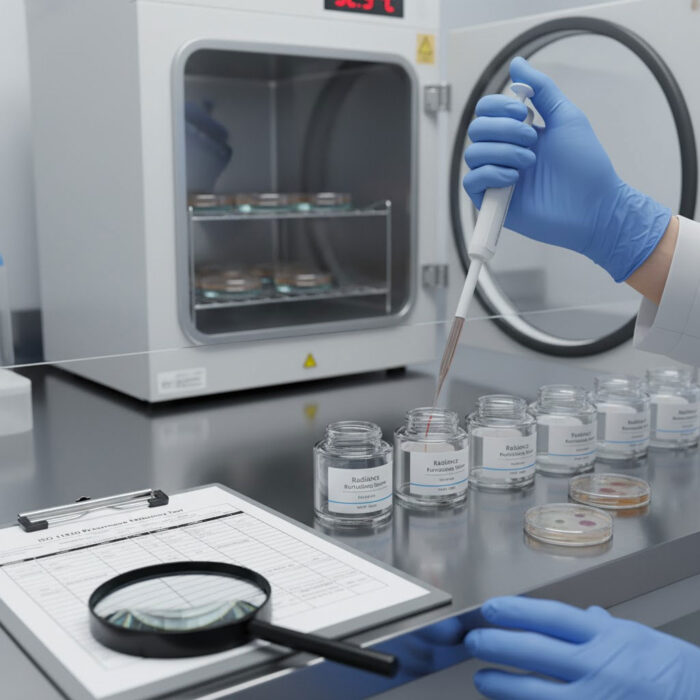
A face cream normally contains a water phase, so the microbiological side of the file matters. The list below is the usual starting point — we confirm it against your actual formulation.
| Test | Usually needed | Why |
|---|---|---|
| Microbiological test (ISO 17516) | Yes | Confirms the finished product meets cosmetic microbiological limits |
| Preservative efficacy / challenge test (ISO 11930) | Yes | Demonstrates the preservative system holds across shelf life and use |
| Accelerated stability and compatibility test | Yes | Supports the shelf life and PAO you print on the pack |
| Certificate of Analysis (physicochemical) | Yes | pH, viscosity, density, appearance and odour for the CPSR |
Testing is arranged through our partner laboratories. If you already hold valid reports, we use yours — you are not asked to repeat work.
This is what we normally ask for to start a face cream safety assessment. You do not need every item on day one — send what you have and we will tell you what is missing.
| Document | Needed |
|---|---|
| Full formulation with INCI names and exact percentages | Always |
| Raw material specifications and technical data sheets | Always |
| Safety data sheets for the raw materials | Always |
| Finished product specification | Always |
| Primary packaging specification (material in contact with the product) | Always |
| Manufacturing method and GMP statement (ISO 22716) | Always |
| Label artwork or draft | Always |
| Stability and packaging compatibility data | Always |
| Emulsion type and phase composition | Always |
| pH of the finished product | Always |
| SPF test report | If an SPF claim is made |
| Fragrance allergen declaration or IFRA certificate | If fragranced |
 Safety Assessment for Face Cream
A safety report proves your product is safe. To legally place it on the EU market you also need an appointed EU Responsible Person — a role we can take on for you.

Reviews
There are no reviews yet