Cosmetics Regulation (EC) No 1223/2009 Leave-on · whole body

Safety Assessment for Body Lotion

New · be the first to review

A Cosmetic Product Safety Report for a body lotion — the largest applied quantity of any leave-on cosmetic, which makes the exposure calculation unforgiving and the restricted-substance limits tighter.

Configure your assessment
Choose your formula size — price updates live

Price range: € 150.00 through € 500.00

Priced by number of ingredients · VAT calculated at checkout · digital delivery
Quantity
Prepared by EU-recognised, VUB-trained Safety Assessors.
Covers Part A (safety information) and Part B (expert assessment).
Written for a body lotion specifically — exposure, tests and warnings to match.
Have a question? Chat with us on WhatsApp
Good to know. A safety report is mandatory, but it is not the whole job. To place your body lotion on the EU market you also need a CPNP notification and an EU Responsible Person — we handle both.
EU-recognised assessors
Signed by qualified, VUB-trained Safety Assessors.
Part A + Part B
Structured exactly to Annex I of Regulation (EC) No 1223/2009.
Test-backed file
Microbiological, challenge and stability data built in.
Transparent pricing
Priced by formula size — published upfront.
How it works

From order to signed report

1

Select & order

Choose your formula size above and order online — no consultation call required.

2

Document collection

We send a secure intake listing exactly what we need for a body lotion. The checklist below is the usual set.

3

Assessment & testing

Your assessor reviews the formulation against Annexes II–VI and calculates exposure. If tests are missing we arrange them with our partner laboratories.

4

Signed report

You receive the signed CPSR digitally, ready to go into your Product Information File.

Safety assessment for a body lotion

Body lotion is applied to the largest surface area of any cosmetic, in the largest quantity, and left on. In exposure terms it is the heaviest leave-on product in a typical routine, and that is why EU restrictions frequently single it out: Regulation (EU) 2024/996, for instance, sets a lower maximum for vitamin A in body lotion than in other leave-on products precisely because of the applied amount.

You receive a full CPSR, Part A and Part B, using whole-body leave-on exposure figures.

What we look at in a body lotion

  • Applied quantity. Whole-body application drives the daily exposure figure, which is what most restricted-substance calculations depend on.
  • Vitamin A and retinyl esters, where body lotion carries its own, lower limit under Regulation (EU) 2024/996.
  • Preservation of a large water phase in a pack used daily under Annex V.
  • Urea, lactic acid and other humectant actives at treatment-level concentrations.
  • Fragrance allergens above the leave-on threshold under Regulation (EU) 2023/1545 — body products are where allergen totals climb fastest.

What you receive

A complete Cosmetic Product Safety Report in two parts, prepared and signed by a qualified Safety Assessor:

  • Part A — safety information. Composition, physicochemical characteristics and stability, microbiological quality, impurities and packaging, the exposure assessment for your body lotion, the toxicological profile of every substance, and any undesirable effects.
  • Part B — safety assessment. The assessor’s reasoned conclusion on whether the product is safe, together with any warnings or usage restrictions that must appear on the label.

Which laboratory tests you actually need

A body lotion normally contains a water phase, so the microbiological side of the file matters. The list below is the usual starting point — we confirm it against your actual formulation.

TestUsually neededWhy
Microbiological test (ISO 17516)YesConfirms the finished product meets cosmetic microbiological limits
Preservative efficacy / challenge test (ISO 11930)YesDemonstrates the preservative system holds across shelf life and use
Accelerated stability and compatibility testYesSupports the shelf life and PAO you print on the pack
Certificate of Analysis (physicochemical)YespH, viscosity, density, appearance and odour for the CPSR

Testing is arranged through our partner laboratories. If you already hold valid reports, we use yours — you are not asked to repeat work.

Typical required documents

This is what we normally ask for to start a body lotion safety assessment. You do not need every item on day one — send what you have and we will tell you what is missing.

DocumentNeeded
Full formulation with INCI names and exact percentagesAlways
Raw material specifications and technical data sheetsAlways
Safety data sheets for the raw materialsAlways
Finished product specificationAlways
Primary packaging specification (material in contact with the product)Always
Manufacturing method and GMP statement (ISO 22716)Always
Label artwork or draftAlways
Stability and packaging compatibility dataAlways
Intended applied amount or pack size and usageAlways
pH of the finished productAlways
Fragrance allergen declaration or IFRA certificateIf fragranced

Why order your body lotion assessment with Lexora

  • Assessed as a body lotion, not as a generic cosmetic. Because so much of it is applied, a body lotion can breach a concentration limit that the identical formula would pass as a face cream.
  • EU-recognised assessors. Signed by qualified, VUB-trained Safety Assessors.
  • No unnecessary testing. We tell you which tests your formulation genuinely needs and which it does not.
  • Transparent pricing. Published upfront and scaled to your formula — no hourly surprises.
  • End-to-end route to market. Pair it with CPNP notification and an EU Responsible Person and you are done.
No. The applied quantity is several times higher, so the exposure calculation and therefore the conclusion are different. A concentration that is safe on the face may not be over the whole body.
By the number of ingredients in your formula. Select the matching tier above (1–9, 10–24, 25–39 or 40+) and the price updates automatically.
A qualified Safety Assessor — a toxicologist, pharmacist or equivalent professional, EU-recognised and trained at Vrije Universiteit Brussel (VUB), as Annex I of the Regulation requires.
No. The CPSR is mandatory but not sufficient on its own. You also need a complete Product Information File, a CPNP notification and an appointed EU Responsible Person. We provide all three.
It depends on the size of the formula and how complete your documentation is. Once your intake is in we confirm a timeline — and if laboratory testing is still outstanding, that is usually what sets the pace.
Yes. The safety report is one component of the PIF. We can assemble the whole dossier, or review the one you already hold.

Reviews

There are no reviews yet

Add a review
Safety Assessment for Body Lotion Safety Assessment for Body Lotion
Rating*
0/5
* Rating is required
Your review
* Review is required
Name
* Name is required

Q & A

Ask a question
There are no questions yet
Complete your compliance

Every EU cosmetic needs an EU Responsible Person

A safety report proves your product is safe. To legally place it on the EU market you also need an appointed EU Responsible Person — a role we can take on for you.

View EU Responsible Person →
Related cosmetics services

Often needed together

Safety Assessment for Body Butter — Lexora EU cosmetic compliance service

Safety Assessment for Body Butter

CPSR for an anhydrous body butter — assessed on oxidation and applied quantity, without microbiological tests…
Price range: € 150.00 through € 500.00 Options

Safety Assessment for Hand Cream — Lexora EU cosmetic compliance service

Safety Assessment for Hand Cream

CPSR for a hand cream — the most frequently reapplied leave-on cosmetic, often on damaged skin,…
Price range: € 150.00 through € 500.00 Options
Water-Based Cosmetic Safety Package

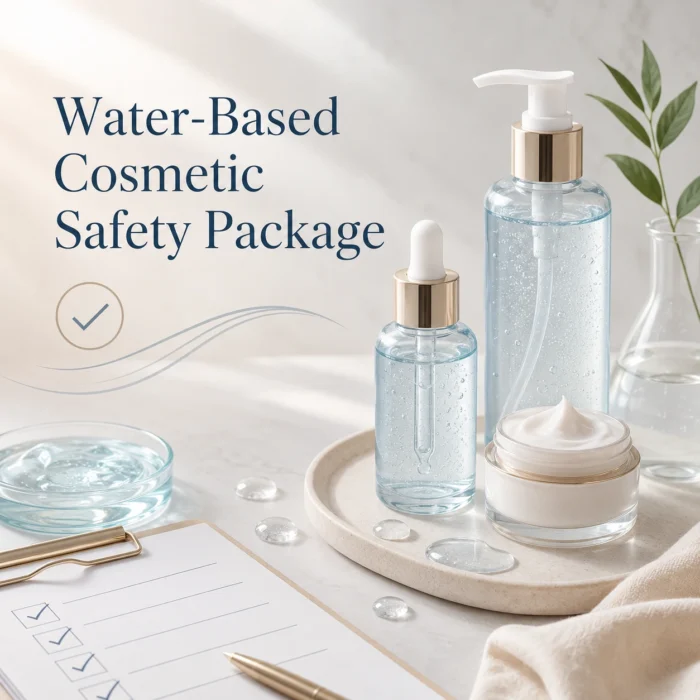
Water-Based Cosmetic Safety Package

The complete safety file for a cosmetic product that contains water — PIF, CPSR, microbiological testing,…
From: Original price was: € 705.00.Current price is: € 634.50. Options