


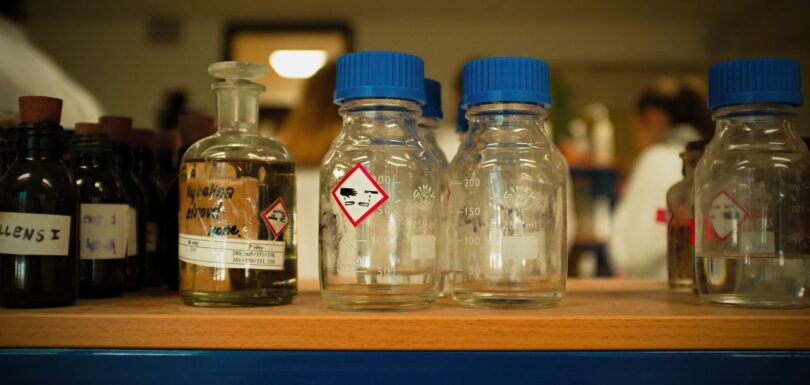
If you sell a hazardous chemical product in the EU — a scented candle, a reed diffuser, a descaler, a drain cleaner — the packaging must meet the CLP label requirements of Regulation (EC) No 1272/2008. Those requirements are precise: they dictate who is named on the label, which red-diamond pictograms appear, whether the signal word is “Danger” or “Warning”, which hazard and precautionary statements are printed, in what languages, and at what size.
Most labels we review fail on at least one of these points — usually not because the classification was wrong, but because an element was left off, printed too small, or written only in English. This article walks through the anatomy of a compliant CLP label and flags the mistakes we see most often.
Key takeaways
- Anyone supplying a hazardous substance or mixture in the EU must label it under CLP — including small makers of candles, diffusers and cleaning products, whose products are often classified mixtures.
- A compliant label combines supplier identity, nominal quantity, product identifiers, hazard pictograms, a signal word, hazard statements, precautionary statements and any supplemental EUH phrases.
- As a rule, no more than six precautionary statements should appear — select the most relevant ones rather than copying the safety data sheet.
- If your mixture triggers a poison centre notification, the UFI code must be printed on the label too.
- The label must use the official language(s) of every Member State where the product is sold — English-only is rarely enough.
- Minimum label and pictogram dimensions scale with package size; fold-out labels and tie-on tags exist for small or awkward containers.
Who actually needs a CLP label?
CLP labelling applies to anyone placing a hazardous substance or mixture on the EU market — manufacturers, importers, reformulators and distributors who put their own name on the pack. The trigger is classification: if the product meets the criteria for any physical, health or environmental hazard class, it must be labelled before it is supplied. If you are new to classification, start with our overview of the CLP regulation.
The businesses most often caught out are small consumer-product makers. A scented candle is legally a mixture of wax and fragrance, and fragrance oils commonly contain skin sensitisers; a reed diffuser is typically a flammable, sensitising liquid; descalers and oven cleaners are frequently corrosive. None is exempt as “just a home fragrance”: if the mixture is classified, the label is mandatory, whatever the scale of the business.
Warning: Fragranced products are the most common blind spot. Even where a candle or diffuser mixture escapes full classification, individual allergens above a modest concentration can still trigger EUH208 — “Contains (name of sensitising substance). May produce an allergic reaction.” It is among the most frequently enforced labelling failures in this sector.
The mandatory elements of a CLP label
Article 17 of CLP lists the elements every hazard label must carry.
Supplier identity and nominal quantity
The label must show the name, address and telephone number of the supplier placing the product on the market, and — for products sold to the general public — the nominal quantity (for example, “500 ml”), unless it appears elsewhere on the packaging.
Product identifiers
For a substance, this is normally the name plus an identifier such as the EC or CAS number. For a mixture, it is the trade name plus the substances driving the main health hazards — a corrosive cleaner must name the corrosive ingredient. Identifiers should match section 1 of the product’s safety data sheet — see our guide to what a safety data sheet contains.
Hazard pictograms
The red diamonds — a black symbol on white inside a red frame — are the GHS pictograms defined in Annex V of CLP. Which diamonds appear follows directly from the classification: the flame for flammables, corrosion for corrosives, the exclamation mark for irritants and sensitisers, and so on, with precedence rules to prevent doubling up.
Signal word
Exactly one signal word appears: Danger for the more severe hazard categories, Warning for the less severe. If any part of the classification calls for “Danger”, “Warning” must not appear anywhere on the label.
Hazard statements (H-phrases)
Each classification carries a standardised hazard statement, such as H319 (“Causes serious eye irritation”) or H317 (“May cause an allergic skin reaction”). All relevant H-phrases must appear, in the exact official wording — paraphrasing is not permitted.
Precautionary statements (P-phrases)
P-phrases tell the user how to handle, store and dispose of the product, and what to do if things go wrong. Here CLP demands judgement: as a general rule, no more than six P-phrases should appear unless the nature and severity of the hazards genuinely require more. Select them for the actual product — a consumer candle does not need workplace-only phrases copied from a raw-material data sheet.
Supplemental information (EUH phrases)
Finally, the label carries any EU-specific supplemental statements: EUH208 for sub-threshold allergens, EUH066 for repeated-exposure skin drying, and EUH210 (“Safety data sheet available on request”) for certain professional supplies. Detergents, biocides and aerosols add their own sector-specific text.
A compliant label at a glance
The table below summarises each element and the mistake we most often find.
| Label element | What it is | Common mistake |
|---|---|---|
| Supplier identity | Name, address and telephone number of the EU supplier | Naming a non-EU manufacturer with no EU entity on the label |
| Nominal quantity | Package contents (e.g. 250 ml) for public sales | Omitted entirely on small consumer packs |
| Product identifiers | Substance name/number, or trade name plus key hazardous ingredients | Brand name only, no hazardous ingredients named |
| Hazard pictograms | Red-diamond GHS symbols matching the classification | Printed too small or with diamonds missing |
| Signal word | “Danger” or “Warning” — never both | “Warning” used where the classification requires “Danger” |
| Hazard statements | Official H-phrases for every classified hazard | Paraphrased wording or missing statements |
| Precautionary statements | Selected P-phrases, generally no more than six | A dozen phrases copied verbatim from the SDS |
| Supplemental information | EUH phrases and sector-specific text | Missing EUH208 “contains [allergen]” on fragranced products |
| UFI code | 16-character code from your poison centre notification | Notification submitted, but UFI never added to the artwork |
The UFI code — when the label must carry it
Mixtures classified for health or physical hazards usually require a poison centre notification under Annex VIII of CLP before going on the market — see our article on how poison centre notification works. The visible half of that obligation is the UFI: a 16-character code, printed on the label with the prefix “UFI:”, which lets a poison centre retrieve your full formulation in an emergency.
The UFI on the pack must match the one in the notification exactly — an old code on a reprinted label, or a code generated but never notified, breaks the chain. We cover the detail in what a UFI code is, and our UFI code generation service can produce and verify codes for you.
Language requirements: label for the market
A CLP label must be written in the official language or languages of each Member State where the product is placed on the market, unless that Member State provides otherwise. Sell the same candle in the Netherlands, Germany and France, and the label text must appear in Dutch, German and French — an English-only label is compliant only where English is an official language, effectively Ireland and Malta.
You may use more languages than required, provided the same details appear in each. Multilingual labels are the practical answer for cross-border sellers, but they eat space quickly — exactly why the six-P-phrase discipline matters.
Note: Translations must use the official CLP wording of each H- and P-phrase, taken from the regulation’s own language versions — a grammatically correct but unofficial rendering is still a non-compliance.
Size, small packaging and awkward containers
CLP sets minimum dimensions for the label and the pictograms, and both scale with the capacity of the packaging. Even on the smallest packages, a pictogram may not shrink below one square centimetre (10 mm × 10 mm) — a rule that catches many 10 ml essential-oil and diffuser-refill bottles.
Where packaging is genuinely too small or awkwardly shaped, CLP offers structured flexibility rather than a free pass: fold-out (peel-back) labels, tie-on tags for containers with no flat face, and in some cases labelling on outer packaging. For packages at or below 125 ml, certain lower-severity hazard categories allow some hazard and precautionary statements to be omitted, though pictograms, signal word and supplier details remain. These exemptions are narrow and hazard-specific — confirm they apply to your classification before relying on them.
Bringing it all together
A compliant CLP label is the visible output of a chain of decisions: classify the mixture correctly, derive the pictograms, signal word and H-phrases, select a disciplined set of P-phrases, add the EUH statements and UFI where they apply, translate into the official wording for each market, and size it lawfully for the package. Break any link and the label fails, however professional the artwork looks. If you would rather have this done properly, our CLP Label Preparation and Review service takes your formulation, confirms the classification and delivers press-ready label content for each language you sell in.
Labelling rarely stands alone: the same classification feeds your safety data sheet and poison centre notification, so it pays to align all three at once — the CLP Compliance Suite bundles them together. For the wider legal context, start with our plain-English explainer on the CLP regulation, and if your product needs a notification, read up on the UFI code before your next print run.
Frequently asked questions
Do candles and reed diffusers really need a CLP label?
Yes — whenever the mixture is classified as hazardous, which is common because fragrance oils frequently contain skin sensitisers and diffuser bases are often flammable. Even sub-threshold allergens can require the EUH208 “contains” statement.
How many precautionary statements can appear on a CLP label?
As a general rule, no more than six precautionary statements should appear, unless the nature and severity of the hazards make more necessary. Choose the most relevant P-phrases rather than copying the safety data sheet.
Does the UFI code have to be printed on the label?
Yes — where a mixture is subject to poison centre notification for health or physical hazards, the UFI must appear on the label with the prefix “UFI:”, matching the notified code exactly. Treat reprints and reformulations as triggers to re-check it.
Can I sell across the EU with an English-only label?
No, except in Member States where English is an official language, such as Ireland or Malta. CLP requires the official language(s) of each Member State of sale, so cross-border sellers normally need multilingual labels.
What is the minimum size for CLP hazard pictograms?
Pictogram and label dimensions scale with the capacity of the packaging, and even on the smallest packages a pictogram may not be smaller than 10 mm × 10 mm. Minimum sizes step up for larger containers.
What is the difference between “Danger” and “Warning” on a label?
“Danger” signals the more severe hazard categories and “Warning” the less severe; only one may appear, and “Danger” takes precedence. The signal word follows automatically from the classification — never a marketing choice.