


A multi-use cosmetics safety assessment answers a question the regulation never asks directly: what happens when one product is sold for three different jobs? A hair and body wash. A face and body balm. A stick sold as blush, lip colour and eyeshadow. Each of those is one SKU with several exposure calculations behind it, and the safety conclusion has to hold for every one.
Multi-use is one of the strongest commercial trends in cosmetics, driven by minimalism, travel formats and refill culture. It is also one of the easiest ways to end up with a safety report that does not cover how your product is actually used. This guide explains why, and how the assessment is scoped properly.
Key takeaways
- Each intended area of use needs its own exposure calculation: applied amount and retention factor differ by site.
- The most conservative area governs. If one use breaches a limit, the product fails even if every other use is comfortable.
- Multi-use is not the same as variants. Variants are several SKUs on one base; multi-use is one SKU used several ways.
- A mixed palette combining eye, lip and cheek products answers to different parts of Annex IV in the same pack.
- Lip use adds an ingestion route that no skin calculation covers.
- Eye-area use pulls in the Annex IV eye-area column even if the product is sold as a face product.
- The label and instructions define the scope. The assessment covers what you tell consumers to do.
- Off-label consumer improvisation is a different question from a marketed multi-use claim.
Why one calculation is not enough
The exposure assessment in Part A of a CPSR runs from four inputs: the concentration of each substance, the amount of product applied per day, the retention factor for the use pattern, and body weight. Two of those change with the area of use.
Applied amount varies enormously. A whole-body application uses far more product than a facial one, which in turn uses more than a lip application. Retention factor varies by a factor of a hundred between rinse-off and leave-on.
Multiply the combinations out and a “face and body” balm has two quite different daily exposure figures behind it. A “hair and body” wash has two. A stick sold for cheeks, lips and eyes has three, plus an ingestion route and an eye-area restriction that the cheek use never triggers. Our guide to how the margin of safety is calculated shows where each input lands in the arithmetic.
There is no single “worst case” that covers everything. Body application gives the largest applied amount. Facial application gives the least forgiving retention factor relative to the surface area. Lip application adds an oral route. Eye-area application adds a colorant restriction. They are genuinely different calculations, and a report that runs one and calls it conservative has not done the work.
Multi-use is not the same as variants
These two get conflated constantly, and they are different problems with different answers.
| Variants | Multi-use | |
|---|---|---|
| What it is | Several SKUs sharing one base formula | One SKU marketed for several areas of use |
| Example | A forty-shade lipstick range | A stick sold for lips, cheeks and eyes |
| What varies | Colour or scent, on a common base | The application site and use pattern |
| Assessment scope | One report covering the base and the full matrix | One report covering several exposure calculations |
| Main risk | A pigment failing Annex IV for the range | One use area breaching a limit the others clear |
| Pricing driver | Number of variants and combined ingredient count | Number of distinct areas of use |
A product can of course be both: a five-shade multi-stick range is variants and multi-use at once. Our guide to when a separate CPSR is required for cosmetic variants covers the variant side in detail.
Where the compliance risk actually sits
Lip use adds an ingestion route
The moment a product is marketed for the lips, a proportion of it is assumed to be swallowed. That tightens acceptable concentrations, restricts colorants to those permitted for lip application under Annex IV, and brings heavy metal traces in pigments under scrutiny against limits that assume ingestion. A pigment perfectly acceptable in a cheek product may not clear the lip column. Our guide to lip colour heavy metal requirements covers this.
Eye-area use adds a colorant restriction
Annex IV carries an explicit exclusion for some colorants from products applied near the eyes. A multi-stick marketed for eyelids, a highlighter used on the brow bone, or a mixed palette with an eyeshadow pan all pull that column into scope. It is a per-pigment check, and one failure takes the product out.
Rinse-off and leave-on in the same product
A hair and body wash is rinse-off for both areas, which is straightforward. A product marketed as a rinse-off mask and a leave-on treatment is not: the retention factor changes from roughly 0.01 to 1 between the two uses, a hundredfold change in systemic exposure. Both scenarios have to be assessed.
Cumulative exposure
The point of a multi-use product is that the same person uses it in several places on the same day. That is not three separate consumers with one exposure each; it is one consumer with a combined exposure. Where the areas are used together, the assessment says so.
Scope is defined by what you market, not by what customers improvise. A shampoo that some customers happen to use as a body wash is a single-area product; a product sold as a “hair and body wash” is two areas. If your packaging, website or advertising tells consumers to use it somewhere, that use is within the reasonably foreseeable use the assessment must cover. If you would rather not carry the second calculation, do not make the second claim.
Mixed palettes
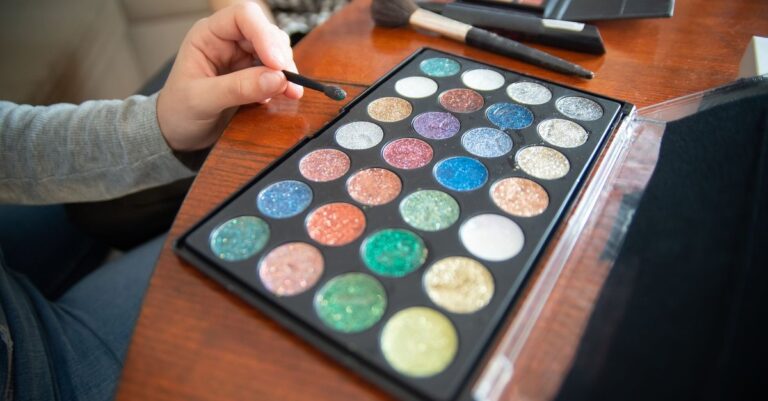
A palette combining eyeshadow, blush and highlighter, or a face palette with a lip pan, is the second form of multi-use. Here the issue is not one formula used in several places but several formulas of different categories sold as one product.
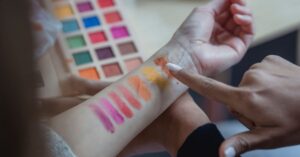
Each category carries its own restrictions. The eye pan answers to the Annex IV eye-area column. The lip pan answers to the lip column and the ingestion route. The cheek pan answers to neither but shares the pack. A palette is therefore scoped by how many distinct cosmetic categories it contains, because each one is a different set of rules and a different exposure model.
Our guides to safety assessment for foundations and make-up and documents needed to order a CPSR cover the make-up file in general.
How to scope it properly
- List every area you market the product for, explicitly. Face, body, hair, lips, eye area, nails.
- State the applied amount and frequency per area, not an average across them.
- State rinse-off or leave-on per area, since a single product can be both.
- Supply the colorant list per category for a mixed palette, with Colour Index numbers.
- Send the draft label and instructions for use, because they define the scope the assessment has to cover.
- Decide which claims you actually need. Dropping a marginal use area from the marketing is a legitimate and often cheaper way to resolve a failing calculation.
That last point is worth dwelling on. If the body use passes comfortably and the lip use fails, you have two options: reformulate, or stop marketing it for lips. The second is free, and it is frequently the right commercial answer for a use case that was never going to drive sales anyway.
Bringing it all together
Multi-use products are sold on the promise that one thing does several jobs. The compliance version of that promise is less convenient: one product, several exposure calculations, and a conclusion that has to hold for all of them.
The failure mode is quiet and predictable. A brand assesses the product for its primary use, adds a second use to the packaging during a marketing review, and never revisits the file. The safety report then covers a product that no longer matches what the label tells consumers to do, which is precisely the gap Article 10 is meant to close.
Get the areas of use fixed before the assessment starts, and keep the label in step with the file afterwards. That is the whole discipline.
Lexora’s multi-use cosmetics safety assessment prices from the standard assessment and adds a surcharge per additional area of use, because that is genuinely additional work rather than a copied paragraph. For single-area products the relevant product-type assessment is cheaper: see the eyeshadow, blush and highlighter, lip balm and body balm assessments. If you are not sure how many areas your product has, contact us before ordering and we will scope it with you.
Frequently asked questions
What counts as a separate area of use?
An area of the body with its own applied amount and retention factor: face, body, hair, lips, eye area, nails. The test is what you market the product for. A product sold as a “hair and body wash” is two areas; a shampoo that some customers also use on their body is one, because you are not telling them to.
Why not just assess the worst case?
Because “worst case” is not a single scenario. Body application gives the largest applied amount, facial application the least forgiving retention factor, and lip application an ingestion route that no skin calculation covers. They are different calculations with different binding constraints, and the report has to show each one.
Is a multi-stick for lips, cheeks and eyes one assessment?
One report, but with three exposure calculations and three sets of restrictions inside it. Lip use adds an ingestion route and restricts colorants to those permitted for the lips. Eye-area use adds the Annex IV eye-area exclusion. Cheek use adds neither. Every pigment has to clear the strictest column that applies.
How is a mixed palette counted?
By the number of distinct cosmetic categories it contains, because each carries different restrictions and its own exposure model. An eyeshadow, blush and highlighter palette is counted differently from an eyeshadow palette alone. Send the pan layout at intake and the scope can be confirmed before you order.
What if one use area fails?
The product fails as marketed, even if every other use is comfortable, because the conclusion has to hold for all intended uses. You then have two options: reformulate, or remove that use from the marketing and the instructions. Dropping a marginal use case costs nothing and is often the better commercial answer.
Can I add a second use to an existing product without a new assessment?
No. Adding a use area changes the reasonably foreseeable use the assessment must cover, so the file has to be updated before the new claim appears on the pack. This is the most common way a product ends up with a safety report that no longer matches its label.
Does a leave-in and rinse-out version of the same formula count as multi-use?
If you market the same product both ways, yes, and it is a significant case. The retention factor changes from roughly 0.01 for rinse-off to 1 for leave-on, so systemic exposure rises about a hundredfold between the two uses. Both scenarios must be assessed, and it has to be scoped that way from the start.