


Key takeaways
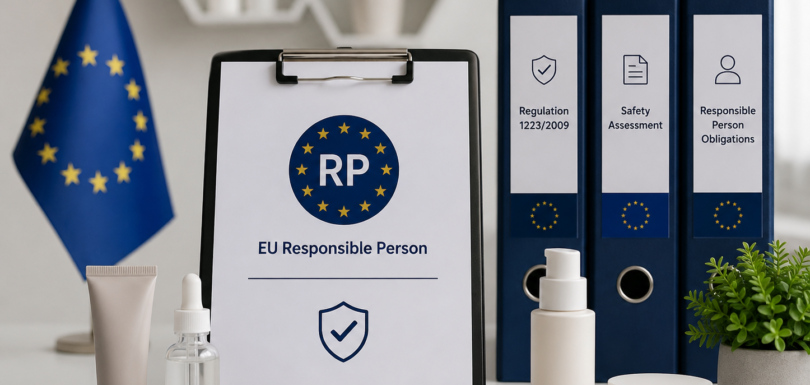
- The Responsible Person (RP) is the EU-based legal entity accountable to the authorities for a cosmetic product’s compliance under Regulation (EC) No 1223/2009.
- No cosmetic can be legally placed on the EU market without a designated RP — there is no exemption for small brands or online-only sellers.
- Non-EU brands cannot act as their own RP from abroad; they must appoint an entity established inside the EU.
- The RP holds the Product Information File, ensures the CPSR is done, manages CPNP notification, and is the contact point for market surveillance authorities.
- Choosing the wrong RP — or trying to skip the role — exposes your brand to product withdrawals, recalls, and delisting from marketplaces.
What is an EU Responsible Person?
The Responsible Person is the single legal entity — a company or a named individual established within the EU — that takes legal accountability for a cosmetic product placed on the European market. The concept sits at the very centre of Regulation (EC) No 1223/2009, the law that governs every cosmetic sold in the 27 member states. In plain terms: when an authority in any EU country wants to know whether your product is safe, legal, and properly documented, the Responsible Person is who they contact. The RP must be named on the product label and must be reachable at an address inside the EU. This is not a formality — it is the mechanism that makes the entire compliance system enforceable.Why does the EU require a Responsible Person?
The single market lets a compliant product move freely between Germany, France, the Netherlands, Italy, and every other member state. For that to work safely, regulators need one accountable point of contact for each product — someone physically reachable within the EU who holds the full compliance file and can answer for the product. The Responsible Person is that anchor. The regulation works on a simple principle: no product on the market without a Responsible Person and a completed safety assessment. There is no grace period, no “sell now, appoint later” route, and no threshold below which a small brand is exempt.What is the Responsible Person legally accountable for?
The RP’s obligations are defined in Article 5 of the Regulation and are far broader than most new sellers expect. The role is ongoing — it does not end once a product launches.| Obligation | What it means in practice |
|---|---|
| Hold the Product Information File (PIF) | Keep the complete dossier accessible at the EU address for 10 years after the last batch. |
| Ensure the safety assessment | Make sure a valid CPSR signed by a qualified assessor exists before sale. |
| CPNP notification | Notify the product on the EU Cosmetic Products Notification Portal before it goes on sale. |
| Label compliance | Ensure the label carries all mandatory information, including the RP’s own name and EU address. |
| Cooperate with authorities | Respond to market surveillance requests and provide documentation on demand. |
| Manage corrective action | Handle non-conformities, undesirable effects, withdrawals, and recalls. |
Why every brand needs one — including non-EU brands
This is the step that catches out most international sellers. A US, UK, or Asian brand cannot simply ship products into the EU and sell them under its own name. To place a product on the market you must either establish a legal entity inside the EU or appoint an EU Responsible Person to act on your behalf. For most brands, setting up and staffing an EU company purely to satisfy this requirement is slow and expensive. Appointing a specialist RP service is the faster, lower-risk route: you get a compliant EU presence, an accountable contact for the authorities, and a partner who already understands the documentation — without incorporating abroad.Responsible Person vs distributor: who is liable?
The two roles are often confused. The Responsible Person carries primary accountability for the product’s compliance. A distributor — a retailer or marketplace seller who makes a product available without changing it — has lighter duties: checking that the label and notification exist, and that the product is within its durability date. However, the line moves the moment a distributor changes the product. If you re-label, re-brand, or translate the labelling in a way that affects compliance, you can become the Responsible Person yourself, inheriting the full set of obligations. Many businesses become an RP by accident this way.How the RP fits into the rest of your compliance file
The Responsible Person does not work in isolation — the role is the hub that ties together every other compliance document:The CPSR and PIF
The RP must ensure a valid Cosmetic Product Safety Report (CPSR) exists and holds the Product Information File (PIF) — the master dossier authorities can request at any time. If you do not yet have these, the RP cannot lawfully let the product be sold. You can order a CPSR through Lexora as part of the same engagement.CPNP notification
Before sale, the product must be notified through the Cosmetic Products Notification Portal (CPNP). The RP is responsible for completing and maintaining this notification across the whole EU.Labelling
The RP’s name and EU address are mandatory label information. A professional label review confirms the RP details and all other required elements are correct before you commit to a print run.How to choose the right Responsible Person
Not every RP offering is equal. Because the role carries liability and holds your technical file, the right partner should:- Be genuinely established in the EU with a real, contactable address.
- Understand cosmetic regulation in depth — not just provide a mailbox.
- Be able to manage the CPSR, PIF, CPNP notification, and labelling together.
- Have a clear process for handling authority requests, undesirable effects, and recalls.
Bringing it all together
The Responsible Person is the keystone of EU cosmetic compliance: the accountable EU entity that holds your file, ensures your safety assessment and notification are in place, and answers to the authorities for your product. Every brand selling into the EU needs one, and for non-EU brands appointing a specialist RP is usually the fastest way into the market. That is exactly where Lexora comes in. We act as your EU Responsible Person and manage the compliance work behind it, so you can access all 27 member states without setting up a European company — and focus on building the brand instead of decoding regulation.Frequently asked questions
Can I act as my own Responsible Person if my company is outside the EU?
No. The Responsible Person must be a legal or natural person established within the European Union. A brand based outside the EU has to appoint an EU-established entity — its importer, its own EU subsidiary, or a third-party service provider acting under written mandate.
Can my distributor or importer be the Responsible Person?
Yes. By default the importer is the Responsible Person for products it brings into the EU, unless it designates another EU-established party by written mandate. Many brands prefer an independent Responsible Person so that changing distributor does not disrupt their regulatory position or leave the file in a competitor’s hands.
Can one product have more than one Responsible Person?
Only one Responsible Person may be designated per product, and their name and address must appear on the label. Different products within the same range can have different Responsible Persons, but a single product cannot have two.
What happens if I change Responsible Person?
The Product Information File must be transferred to the new Responsible Person, the CPNP notification updated, and the label changed to show the new name and address. Because artwork has to be reprinted, changing Responsible Person is rarely a quick administrative step — plan it alongside a packaging cycle.
Is the Responsible Person legally liable for the product?
They carry the regulatory responsibility for compliance: holding the file, ensuring the safety assessment exists, notifying the product, dealing with authorities and taking corrective action. This is distinct from product liability for damage, which follows separate rules and normally rests with the manufacturer.