


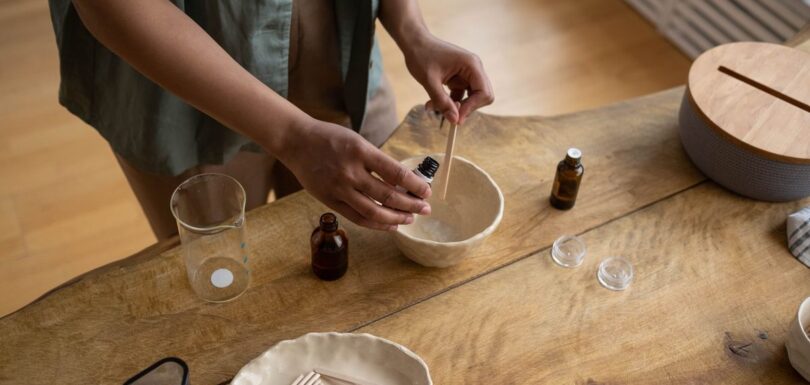
Plenty of established EU beauty brands started at a kitchen table, so it is natural to ask whether you can legally sell cosmetics from home. The answer is yes: EU law does not require a factory or a minimum company size before you sell cosmetics from home or anywhere else. What it does require is full compliance with Regulation (EC) No 1223/2009 — the EU Cosmetics Regulation — which applies to every cosmetic placed on the market, whether it leaves a production line or a spare-room workshop.
That single point shapes everything else. There is no “handmade”, “small batch” or “hobbyist” exemption anywhere in the regulation: a bar of soap sold at a village craft fair is placed on the EU market in exactly the same legal sense as a supermarket shampoo. Below, we translate each requirement into home-workshop practice.
Key takeaways
- Selling home-made cosmetics is legal across the EU, but Regulation (EC) No 1223/2009 applies in full — there is no small-batch exemption.
- Every product needs a CPSR signed by a qualified safety assessor before its first sale.
- Manufacture must follow cosmetic GMP (ISO 22716): a controlled workspace, written procedures and batch traceability.
- Each product must be notified on CPNP before sale and carry compliant Article 19 labelling, including the INCI list.
- EU-based makers can act as their own Responsible Person.
- Business registration, liability insurance and local health rules sit outside the regulation and vary by Member State.
Selling from home is legal — but the regulation applies in full
The Cosmetics Regulation attaches its obligations to placing a product on the market — making a cosmetic available on the EU market for the first time in the course of a commercial activity. How many units you produce, and where, is irrelevant. A craft-fair stall, a farmers’ market, an Etsy shop, an Instagram checkout and your own website all count; so does supply free of charge in the course of business, such as samples.
One misconception is worth killing early: “handmade”, “natural” and “artisanal” are marketing terms with no regulatory status — such products meet exactly the same requirements as any other cosmetic. For the complete framework, see our pillar guide to how to legally sell cosmetics in the EU.
Good manufacturing practice in a home workshop
Article 8 requires manufacture under good manufacturing practice, with compliance presumed where it follows the harmonised standard ISO 22716. Crucially, ISO 22716 demands no cleanroom or third-party certification — just discipline and documentation proportionate to the operation. At home, that typically means:
- A dedicated or strictly segregated workspace with cleanable surfaces, not shared with family cooking during production, and off-limits to pets.
- Controlled storage: raw materials, packaging and finished goods kept separately and logged with supplier lot numbers.
- Written procedures and records: cleaning routines, equipment reserved for production, and a batch record for every run — formula as made, quantities, raw-material lots, date, yield.
- Batch traceability: every unit carries a batch number linking a complaint back to the exact run so it can be withdrawn if needed.
Note: ISO 22716 is meant to be applied in proportion to the size of the business. Inspectors expect clean, controlled conditions and honest records from a micro-producer — not pharmaceutical-grade infrastructure — but production with no documentation at all is never acceptable.
The paperwork: CPSR, Product Information File and CPNP
The safety assessment (CPSR)
Before any cosmetic is placed on the market, Article 10 requires a safety assessment recorded in a Cosmetic Product Safety Report. Part A compiles the safety data — full formula, ingredient toxicological profiles, stability, microbiological quality (including a preservation challenge test where a product can support microbial growth) and expected exposure — and Part B is the assessor’s signed conclusion that the product is safe. The signatory must hold a university qualification in pharmacy, toxicology, medicine or a similar discipline, so this is the step nearly every home producer outsources. Our CPSR service covers it end to end, and our explainer on what a CPSR contains is a good primer. Soap makers should also read our guide to handmade soap safety and microbiological testing.
The Product Information File (PIF)
Article 11 requires a Product Information File for each product, kept at the Responsible Person’s address shown on the label and available to authorities on request. It holds the product description, the CPSR, a GMP statement, evidence for any claimed effects and animal-testing data, retained for ten years after the last batch is placed on the market.
CPNP notification
Article 13 requires each product to be notified on the Cosmetic Products Notification Portal (CPNP) before it goes on sale. The portal is free; the notification covers the product category and frame formulation, the label and the Responsible Person’s details, so poison centres across the EU can identify the product. Our CPNP Notification service handles it for you.
Warning: Selling even one unit before the CPSR is signed and the CPNP notification submitted places a non-compliant product on the market: authorities can order withdrawal, recall and destruction of stock, and national laws attach fines. See what happens if you sell non-compliant cosmetics in the EU.
The table below maps each obligation to what it looks like in a home workshop.
| Legal requirement | Legal basis | What it means for a home producer |
|---|---|---|
| Good manufacturing practice | Article 8 (ISO 22716) | Segregated, cleanable workspace; written cleaning and batch records; traceable batch numbers. |
| Safety assessment (CPSR) | Article 10, Annex I | Commission a qualified assessor per product before the first sale. |
| Product Information File | Article 11 | A dossier per product, kept at the address on your label for ten years after the last batch. |
| CPNP notification | Article 13 | Notify every product on the free EU portal before sale — fairs and online included. |
| Compliant labelling | Article 19 | INCI list, quantity, durability marking, batch number, function, precautions, your name and address. |
| Responsible Person | Articles 4–5 | As an EU-based maker selling under your own name, you are the RP by default. |
Labelling a handmade cosmetic correctly
Article 19 sets out what must appear on the container and packaging, and home-made products are checked against it word for word. Every unit needs:
- The name and address of the Responsible Person — usually your own name and the address where the PIF is kept.
- The nominal content in grams or millilitres (limited exceptions for very small and single-use sizes).
- A durability marking: a “best before” date where minimum durability is 30 months or less, otherwise the open-jar period-after-opening (PAO) symbol with a period in months.
- Any precautions for use, the batch number, and the product’s function unless obvious from its presentation.
- An ingredient list headed “Ingredients” using INCI names, in descending order down to one per cent, then in any order, with certain fragrance allergens named individually above small thresholds — a recently expanded list, so check your supplier’s allergen declaration.
Member States may also require certain particulars, such as precautions and function, in their national language — plan label space accordingly.
Acting as your own Responsible Person
Every cosmetic on the EU market must have a Responsible Person (RP) established within the EU. If you manufacture in the EU and sell under your own name, you are the RP by default; alternatively, you may appoint another EU-established person or company by written mandate. The role is not a formality: the RP guarantees ongoing compliance, holds the PIF, submits the CPNP notification, reports serious undesirable effects and takes corrective action — up to recall — if a problem emerges. Acting as your own RP is entirely feasible, but only if your documentation genuinely exists and stays current; see our explainer on what an EU Responsible Person does.
What the regulation doesn’t cover
Regulation 1223/2009 governs the product; it says nothing about running a home business. Several practicalities are set by national or local law and vary between Member States:
- Business registration and tax. You will normally need to register as a sole trader or company and handle VAT under national rules.
- Local rules on home production. Some countries or municipalities require notifying a local health or trade authority that cosmetics are made at your address, and premises may be inspected.
- Product liability insurance. Not required by the regulation, but selling without cover is a risk no assessor would endorse — and many market organisers ask for an insurance certificate.
- Consumer and distance-selling law. Online sales add EU consumer-rights obligations on top of cosmetics law.
Bringing it all together
So, can you sell cosmetics from home in the EU? Yes — the legality was never in doubt. The real question is sequencing the compliance work: lock your formula, run stability and any microbiological testing, commission the CPSR, assemble the PIF, notify on CPNP, finalise the label, and only then make the first sale. None of these steps cares whether you produce twenty units or twenty thousand; costs scale down, but no step disappears.
For a small, low-risk product line, Lexora’s Essential Safety Set bundles the core of that work — the safety assessment and notifications standing between a finished recipe and a legal first sale — into one starter package sized for home producers. If you are still mapping the wider journey, our guide to starting a cosmetic brand in the EU turns these obligations into a launch checklist, and if your route to market is a webshop, read whether you need a CPSR to sell cosmetics online.
Frequently asked questions
Is it legal to sell homemade cosmetics in the EU?
Yes — selling homemade cosmetics is legal in every EU Member State, provided each product fully complies with Regulation (EC) No 1223/2009: GMP manufacture, a signed CPSR, a Product Information File, CPNP notification, compliant labelling and an EU Responsible Person. There is no handmade or small-batch exemption.
Do I need a CPSR to sell at craft fairs and markets?
Yes. Selling at a craft fair, market or pop-up counts as placing the product on the EU market, so the CPSR, CPNP notification and full labelling apply exactly as for shop or online sales — even for a single stall on a single day.
Can I write my own cosmetic product safety report?
Only if you hold a university qualification in pharmacy, toxicology, medicine or a similar discipline, as Article 10 requires. Most home producers commission a qualified safety assessor, who reviews the formula, supplier documents and test data before signing Part B.
Do I need a separate room at home to make cosmetics?
Not necessarily a separate room, but you do need a controlled, documented production environment under ISO 22716: a cleanable workspace used only for production, equipment reserved for cosmetics, segregated storage, and written cleaning and batch records.
Do I have to register anywhere besides CPNP?
Usually yes, under national rather than EU cosmetics law. You will normally need to register your business and handle VAT in your Member State, and some countries also require notifying a local health or trade authority that cosmetics are produced at your home address.