


A product-specific safety assessment is the same legal document as any other CPSR, but it is not the same piece of work. Regulation (EC) No 1223/2009 asks for one thing: a Cosmetic Product Safety Report, Part A and Part B, signed by a qualified assessor. What it does not tell you is that the exposure model behind that report changes completely depending on whether your product is a face serum, a bar of soap, a lipstick or a body oil.
That is why Lexora now publishes a separate safety assessment page for each product type rather than a single generic CPSR listing. This guide explains what actually differs between them, why the price differs too, and how to pick the right one for what you are selling.
Key takeaways
- Every cosmetic needs a CPSR. The legal requirement is identical; the assessment behind it is not.
- The exposure model changes by applied amount, retention factor, application site and route. A body lotion and a face cream are not the same calculation.
- Anhydrous formats (oils, butters, balms, wax sticks, powders, bar soap, perfume) usually avoid challenge and microbiological testing, provided the rationale is written into the file.
- Lip products are assessed against ingestion, which tightens colorant and heavy metal limits well beyond skin products.
- Shade ranges are one assessment, not one per shade, when they share a base formula. Paying per colour is the most common overspend in make-up compliance.
- Babies, children and pregnancy need a rebuilt exposure model, not an adjusted adult one.
- Picking the wrong product type does not just cost money. It produces a report that answers the wrong question.
What the regulation actually requires
Article 10 of Regulation (EC) No 1223/2009 requires a safety assessment before a cosmetic product is placed on the EU market. Annex I sets out the structure: Part A collects the safety information (composition, physicochemical data, microbiological quality, impurities, exposure, toxicological profile), and Part B is the assessor’s reasoning and signed conclusion.
Nothing in Annex I says “use these numbers for a shampoo and those numbers for a lipstick”. It says the assessment must reflect the reasonably foreseeable use of the product. That single phrase is where all the difference comes from. Our guide to what a CPSR is covers the document itself; this article covers what changes underneath it.
The four variables that change everything
1. Applied amount
The daily applied quantity is the first input into the exposure calculation, and it varies by an order of magnitude across the catalogue. A face cream sits around 1.5 g per day. A body lotion covers the largest surface area of any cosmetic and uses a much higher figure. That is not a detail. It is the reason Regulation (EU) 2024/996 set a lower maximum for vitamin A in body lotion than in other leave-on products.
The practical consequence: a concentration that passes comfortably in a face cream can fail in a body lotion with the identical formula. You cannot reuse the assessment.
2. Retention factor
Rinse-off products carry a retention factor of roughly 0.01, reflecting that about 1% of what is applied stays on the skin. Leave-on products use a factor of 1. That is a hundredfold difference in systemic exposure from the same formula.
This is also the most common scoping error we see. A conditioner sold as a rinse-out and a conditioner sold as a leave-in are the same chemistry and two different assessments. Tell your assessor which one you are actually selling.
3. Application site
Where the product goes decides which restrictions apply. Annex IV, the colorant list, has a column stating whether a permitted colorant may be used near the eyes, and a separate condition for lip application. A pigment that is fine in a blush can be prohibited in an eyeshadow, and a concealer marketed as a face product is used under the eye, so the eye-area column applies to it whether the marketing says so or not.
4. Exposure route
Most cosmetics are assessed dermally. Lip products are not. A measurable proportion of any lip balm, gloss or lipstick is swallowed in normal use, so the assessment uses an oral route for part of the applied amount. Nail polish adds inhalation, because the solvent system evaporates during application.
How the product types group
| Group | Product types | What drives the assessment |
|---|---|---|
| Water-based leave-on | Face serum, face cream, face toner, body lotion, hand cream | Preservation under Annex V, restricted actives, full challenge and microbiological testing |
| Water-based rinse-off | Shampoo, conditioner, hair mask, liquid soap | Rinse-off retention factor, surfactant tolerance, eye contact, preservation of a large water phase |
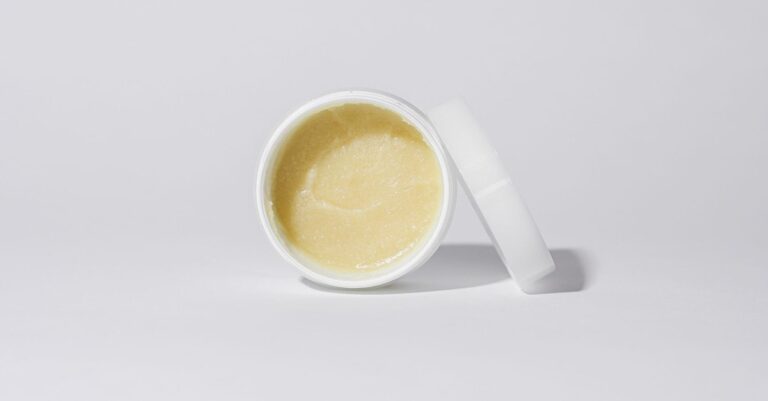
| Anhydrous | Body butter, body oil, body balm, lip balm, lip oil, bar soap, perfume | Oxidative stability, essential oil constituents, allergen totals. Challenge testing usually not required |
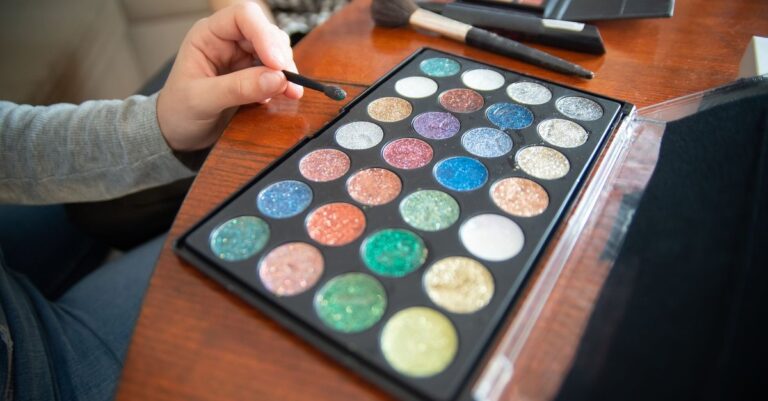
| Shade-based make-up | Foundation, concealer, eyeshadow, blush, lipstick, nail polish | One base formula plus a pigment matrix, Annex IV shade by shade, heavy metal traces |
| Sensitive populations | Baby (0 to 3), children, pregnancy | Exposure model rebuilt on paediatric or targeted parameters, age-restricted substances |
| Multi-use | Hair and body wash, face and body balm, mixed palettes | A separate exposure calculation per area of use, with the most conservative one governing |
Group membership is decided by the formula, not by the marketing name. A “body butter” containing 20% water is a water-based emulsion and needs the full testing set. A “cream blush” with a water phase needs preservation that a pressed powder does not. Send the quantitative formula, not the product name.
Where the anhydrous saving is real
Microbial growth needs available water. Remove the water phase and the microbiological question largely disappears, which is why a body butter, a wax lip balm, a solvent-based nail polish, a saponified bar soap or a high-alcohol perfume normally does not need preservative efficacy testing to ISO 11930 or microbiological limits to ISO 17516.
The catch is that you have to justify it. ISO 29621 sets out how a product is shown to present a low microbiological risk, and the reasoning belongs in the Product Information File. Assert the exemption without the reasoning and an inspector reads it as a gap, not a saving. Our article on why anhydrous cosmetics need fewer tests covers the logic, and which cosmetic tests you actually need maps the full set by product group.
Anhydrous does not mean risk-free. Oils and butters oxidise, so the antioxidant system and shelf life have to be justified instead. Natural oil blends routinely exceed fragrance allergen declaration thresholds through their essential oil constituents, and expressed citrus oils raise a phototoxicity question. The work moves, it does not vanish.
Why shade ranges are one report
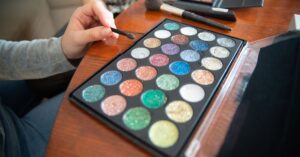
A forty-shade foundation launch is one emulsion with forty iron oxide loadings. A twelve-pan eyeshadow palette is one powder base with twelve pigment loadings. A hundred-colour nail polish range is one lacquer plus a May Contain (+/-) pigment list.
Assessing each shade separately would be dozens of near-identical reports, and it is the single most expensive mistake a colour cosmetics brand makes. The honest model prices the work by how many shades share the base and how large the combined ingredient list is. What still has to be done individually is the Annex IV check: every pigment in the matrix has to clear the list, with its purity criteria, for the application site in question.
Where the same base is genuinely varied in scent or colour without changing the underlying formula, the same logic applies outside make-up. Our guide to when a separate CPSR is required for variants sets out where the line falls.
Sensitive populations are a different calculation, not a stricter one
Cosmetics for children under three, cosmetics for older children, and cosmetics marketed to pregnant customers all sit above the standard tier for the same reason: the exposure model is rebuilt rather than adjusted.
Infants have a higher body-surface-area to body-weight ratio and an immature skin barrier, so the same concentration produces a higher internal dose. Annex III and Annex V contain entries that specifically exclude children under three, and salicylic acid is the one most often missed. Children apply more product, more often, and put face paint and glitter in their mouths. Pregnancy is different again: there is no legal category of “pregnancy-safe cosmetic” in EU law, so the work is a targeted review of the substances of concern plus an assessment of whether the claim itself is defensible.
Our guide to safety assessment for baby cosmetics covers the paediatric side in detail.
How to choose the right one
- Start from the formula, not the name. Does it contain water? That decides the testing set before anything else.
- State the real use pattern. Rinse-off or leave-on. One area of use or several. Adult, child or infant.
- Count the shades sharing a base. If you sell a range on one formula, say so at intake and pay for one assessment.
- Flag every claim. An SPF claim brings Annex VI and substantiated SPF testing into scope. An antibacterial claim may move the product into the Biocidal Products Regulation entirely.
- Screen first if you are unsure. A formula screening against Annexes II to VI costs a fraction of a CPSR and tells you whether the formula can be made compliant at all.
Whichever type you order, the document set you have to assemble is broadly the same. Our checklist of documents needed to order a CPSR covers each item, and who can sign a CPSR explains the assessor qualification requirement.
Bringing it all together
One legal requirement, many different pieces of work. The regulation is short on this point and industry practice has filled the gap badly, either by selling a single generic report that quietly uses the wrong exposure figures, or by charging per shade for a range that is one formula. Neither serves a brand well.
Get three things right at intake and the assessment is straightforward: the true water content, the true use pattern, and the true number of variants sharing a base. Get them wrong and you either pay for tests you do not need or receive a conclusion that does not cover how your product is actually used.
Lexora now publishes a separate safety assessment for each of these product types, priced by ingredient count rather than by guesswork, and each one is a full CPSR signed by a qualified EU Safety Assessor. If you are not sure which applies, start with a cosmetic formula screening, or order the standard CPSR and we will scope it with you.
Frequently asked questions
Is a product-specific safety assessment legally different from a normal CPSR?
No. It is the same document required by Article 10 of Regulation (EC) No 1223/2009, with the same Part A and Part B structure under Annex I, signed by the same qualified assessor. What differs is the exposure model, the annex checks and the testing set used to produce it, all of which follow from the product type.
Can I reuse one CPSR across my whole range?
Only where the products genuinely share a base formula and the same use pattern, such as a shade range built on one emulsion. A face cream and a body lotion with the same formula need separate assessments because the applied quantity differs. See our guide to separate CPSRs for cosmetic variants.
Does an anhydrous product really skip the challenge test?
Normally yes, provided the formula has no water phase and the rationale is documented in the file under ISO 29621. That covers oils, butters, wax balms, powders, saponified bar soap and high-alcohol perfume. If any water is present, or the product is packed in an open jar used with wet hands, the exemption may not hold and the assessor will say so.
Why are lip products more expensive to get right?
Because they are assessed against an ingestion route. A proportion of what is applied is swallowed, so acceptable levels tighten, colorants must be permitted for lip use under Annex IV, and heavy metal traces in pigments are assessed against limits that assume swallowing rather than skin contact.
How many shades can share one assessment?
As many as genuinely share the base formula. Pricing follows the number of shades and the size of the combined ingredient list, including everything declared under May Contain (+/-). Every pigment still has to clear Annex IV individually for the application site, which is the work the price actually buys.
What if my product is used on more than one part of the body?
Each intended area of use needs its own exposure calculation, and the conclusion has to hold for all of them. A hair and body wash, a face and body balm, or a mixed-category palette is a multi-use assessment. The most conservative area governs: if one use breaches a limit, the product fails even if every other use is comfortable.
Should I screen my formula before ordering a CPSR?
If you have any doubt about an ingredient, yes. A screening against Annexes II to VI checks whether each substance is permitted at your concentration for your product type. It is not a safety report and has no assessor signature, but it is the cheapest place to discover that a formula cannot be made compliant.