


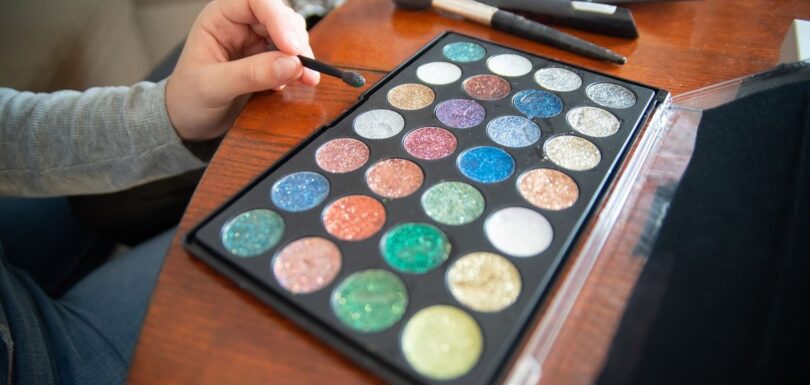
An eyeshadow safety assessment lives or dies on one column of Annex IV. Regulation (EC) No 1223/2009 lists the colorants permitted in cosmetics, and against several of them sits a condition saying they may not be used in products applied near the eyes. A twelve-pan palette fails on one pan as completely as on all twelve.
That single check causes more colour cosmetics reformulations than anything else, and it reaches further than brands expect: it applies to highlighters used on the brow bone, to concealers used under the eye, and to any product whose real application site is not the one on the marketing brief. This guide covers what a qualified assessor examines in powder colour, how pigment heavy metals are handled, and why a palette is one assessment rather than twelve.
Key takeaways
- Annex IV has an eye-area condition. Some permitted colorants may not be used near the eyes, and that check comes before everything else.
- The restriction follows how the product is used, not how it is marketed. Highlighters and concealers reach the eye area.
- Heavy metal traces in mineral pigments are assessed as technically unavoidable impurities under Article 17.
- Talc requires asbestos-free certification from the supplier, per batch source.
- Loose powders raise an inhalation question that pressed powders largely avoid.
- Glitter and effect pigments engage the synthetic polymer microparticle restriction in Regulation (EU) 2023/2055.
- A palette on one base formula is one CPSR, priced by shades and ingredient count.
- Pressed powder is anhydrous, so challenge and microbiological testing normally fall away. A cream blush containing water does not.
The eye-area column
Annex IV lists each permitted colorant with its Colour Index number, the product types it may be used in, its maximum concentration where one applies, and its purity criteria. For a subset of entries there is an explicit exclusion from products applied in the eye area.
The reason is practical rather than theoretical. The conjunctiva is a mucous membrane, the skin of the eyelid is the thinnest on the body, and powder migrates. A pigment that is perfectly safe on a cheek is a different proposition a few millimetres from the eye.
What makes this expensive is that the check has to be done pigment by pigment across the whole matrix, including every entry in the May Contain (+/-) list. Brands routinely assess the base formula carefully, then assume the pigment set is fine because it is used elsewhere in the range. One deep navy or one bright coral can take the palette out.
The restriction follows the application site, not the product category. A highlighter marketed as a face product is applied to the brow bone and the inner corner of the eye. A concealer marketed as a face product is applied directly under the eye. Both pull the Annex IV eye-area condition into scope even though neither is sold as an eye product. Assess how consumers actually use it, because that is what “reasonably foreseeable use” means in Article 10.
Heavy metals in mineral pigments
Iron oxides, ultramarines, chromium oxides, manganese violet, mica and titanium dioxide are mined or synthesised from mineral sources, and they carry trace metals as an unavoidable consequence. Lead, arsenic, cadmium, mercury, antimony, chromium and nickel are the ones assessors look for.
There is no blanket numerical limit for these in the Cosmetic Regulation. Instead, Article 17 permits the non-intended presence of a prohibited substance only where it is technically unavoidable in good manufacturing practice and the product remains safe under Article 3. That means the judgement is made in your safety assessment, using your pigment certificates of analysis and your exposure figures, rather than by ticking a number off a list.
Practically, that makes pigment documentation non-negotiable. A Colour Index number alone is not enough. The assessor needs the supplier’s purity data and heavy metal results for the grade you are actually buying. Our guide to heavy metal testing for lip colour covers the same problem where the exposure route is ingestion rather than the eye.
Talc, mica and inhalation
Two questions attach to the fillers rather than the colour.
Talc needs asbestos-free certification. Talc and asbestos occur in the same geological formations, so the certification is about the source and the batch, not about talc as a substance. Ask for it per supply, not once at onboarding.
Loose versus pressed format decides whether inhalation is a live question. A pressed pan releases very little airborne particulate in use. A loose pigment jar, a setting powder or a loose highlighter does, and the assessment should account for a respirable fraction. It is one of the reasons the same pigment set can pass in a palette and raise questions as a loose product.
Effect pigments and glitters are now a regulatory question in their own right. Regulation (EU) 2023/2055 restricts synthetic polymer microparticles under REACH, with staged transitional periods that are progressively removing loose plastic glitter from cosmetic use. If you are developing a new palette, design around mineral, cellulose or biodegradable effect pigments rather than around the end of a transitional period.
Powder or cream: the testing set changes
| Format | Water phase | Challenge and micro testing | Extra scrutiny |
|---|---|---|---|
| Pressed powder eyeshadow | No | Normally not required | Annex IV eye area, heavy metals, talc certification |
| Loose pigment or shadow | No | Normally not required | All of the above plus inhalation exposure |
| Pressed blush, bronzer, contour | No | Normally not required | Annex IV, heavy metals, effect pigments |
| Cream blush or highlighter | Usually yes | Required | Preservation under Annex V plus all pigment checks |
| Liquid highlighter or shimmer drops | Yes | Required | Preservation, applicator hygiene, pigment checks |
| Cream eyeshadow stick | Usually no | Normally not required | Annex IV eye area, wax stability, applicator hygiene |
Where a formula is anhydrous, the exemption from ISO 11930 challenge testing and ISO 17516 microbiological limits has to be justified in the Product Information File under ISO 29621, not simply assumed. Our article on why anhydrous cosmetics need fewer tests covers the reasoning, and which cosmetic tests you actually need maps the set by product group.
One base formula, one assessment
A twelve-pan palette is one powder base with twelve pigment loadings. A blush, bronzer, contour and highlighter range is usually the same base again with different colour and effect systems. Assessed properly, that is one CPSR covering the base and the whole pigment matrix.
Charging per pan is the most expensive mistake a colour brand makes, and it is not what the regulation asks for. What genuinely has to be repeated per shade is the Annex IV check and the pigment purity review, which is why pricing should follow the number of shades and the size of the combined ingredient list rather than the number of SKUs.
The same logic runs across the make-up catalogue. Our guides to safety assessment for foundations and make-up and when a separate CPSR is required for variants cover where a range genuinely splits into two assessments.
What to have ready
- Base formula with the full pigment matrix per shade, percentages not ranges.
- Colour Index numbers for every pigment, including everything under May Contain (+/-).
- Pigment purity data and heavy metal analysis for the grades you buy.
- Asbestos-free certificate for talc, per supply source.
- Loose or pressed format stated explicitly.
- Effect pigment composition, so the microplastics restriction can be checked.
- Packaging and applicator specification, including any sponge or brush supplied with the product.
- Number of shades sharing the base, which scopes the assessment.
- Draft artwork with the INCI list and the May Contain declaration written correctly.
Our checklists of documents needed to order a CPSR and how to prepare an INCI list cover each item.
Bringing it all together
Colour cosmetics compliance is pigment compliance. The base formula is usually the least interesting part of the file, and the pigment matrix is where an assessment succeeds or fails: the eye-area column, the purity criteria, the heavy metal traces, the effect pigments under the microplastics restriction.
Two habits prevent most problems. Check every pigment against the application site consumers actually use rather than the one on the marketing brief. And get the pigment documentation at the point of purchase, because chasing certificates of analysis retrospectively from a supplier who has already shipped is the slowest part of any make-up assessment.
Lexora assesses colour ranges as ranges. The eyeshadow safety assessment covers a full palette on one base formula, the blush, contour and highlighter assessment covers a face colour range, and the concealer assessment takes the under-eye application properly into account. For a palette combining different cosmetic categories in one product, the multi-use assessment is the right scope.
Frequently asked questions
Why can I use a pigment in blush but not in eyeshadow?
Because Annex IV attaches conditions to individual colorants, and several permitted colorants carry an explicit exclusion from products applied in the eye area. The eyelid is the thinnest skin on the body and the conjunctiva is a mucous membrane, so the condition reflects a genuinely different exposure. The check is per pigment, not per formula.
Does the eye-area restriction apply to a highlighter?
If it is used on the brow bone or the inner corner of the eye, yes. Article 10 requires the assessment to reflect reasonably foreseeable use, and highlighters are routinely applied around the eye whether or not they are marketed that way. The same applies to concealer, which is a face product used under the eye.
Are there fixed heavy metal limits for cosmetic pigments in the EU?
Not as a numerical list. Article 17 permits the non-intended presence of prohibited substances only where it is technically unavoidable under good manufacturing practice and the product remains safe. The judgement is therefore made in your safety assessment using your pigment certificates of analysis and your exposure figures, which is why the supplier data matters so much.
Do I need a separate assessment for each pan in a palette?
No. A palette built on one base formula with different pigment loadings is one assessment covering the base and the full pigment matrix. The price should follow the number of shades and the combined ingredient list rather than the number of pans. Every pigment still has to clear Annex IV individually, which is the work involved.
Is talc still allowed in EU cosmetics?
Yes, and it is widely used as a filler in pressed powders. What the assessment requires is asbestos-free certification for the grade and source you buy, because talc and asbestos occur in the same geological formations. Ask for the certification per supply rather than once at supplier onboarding.
Does a loose pigment need more work than a pressed one?
Usually yes. A loose powder generates airborne particulate in use, so the assessment has to consider a respirable fraction that a pressed pan largely avoids. Particle size data and the packaging format both feed into that, and it is a common reason the same pigment set passes as a pressed shadow and raises questions as a loose one.
Can I still launch a glitter palette?
Only with the right glitter. Regulation (EU) 2023/2055 restricts synthetic polymer microparticles under REACH with staged transitional periods that are progressively removing loose plastic glitter from cosmetic use. New formulations should be built on mineral, cellulose or certified biodegradable effect pigments rather than designed around the remaining transition.